
 Country Family
Baton Rouge
Country Family
Baton Rouge
A - F
Basquine
The Basquine was a top stiffed with boning and made of linnen or cotton, which went to the ruff and was fixed with a lace. It was worn in 16th century over a cotton shirt, whose ends were stuck in a pantoon made of luxurious fabric.
Bra
During the world exhibition 1900 in Paris different bra models were presented. Cadolle produced its first breast-holder 1889, but there had to be found a solution for fixation; the first bra of house Cadolle was the "bien-être" (well-being) which was fixed at the back on a corsage.
Caresse Crosby (Mary Ohelps Jacobs pseudonym) invented a new bra in the United States in 1913: a short model, which divided the bust. 1914 she sold her patent to the company Warner Bros. At the same time Rosalia Kind (headmistress of Kestos) brought out a bra composed of two triangles, crossed in front and in the back.
Corset
After the return of the monarchy the corsage, which disappeared in oblivion during the revolution, received a lasting reanimation caused by the new moral order under Louis XVIII. The woman had to be a good mother and spouse.
For the first time in its history the corsage became under-garment. Even more despotic as the corsage of the 18th century it squeezed the breast in cups and presses together the thighs. Waist cushions grant abundant sphericity to the woman. It was slipped over the shirtund worn under the dress. It was stripped at the back with the aid of a system that allowed the woman, to dress herself. It was called Corset à la paresseuse, the "comfortable corsage".
Cotte
The cotte is a garment worn both from men and women, which could also be called shirtdress. It was worn over the invisible undershirt and under the Surcot. Sometimes it was also worn without Surcot. Maybe we can simply say, that it is a matter of dress, not forgetting that there is a upper dress to this dress.
The Cotte should not be mistaken with the undershirt, because in opposite to the shirt it is visible at the neckline and often also at the sleeves and seam, when worn under a Surcot. That is also the reason why those areas often were occupied by embroidery and borders.
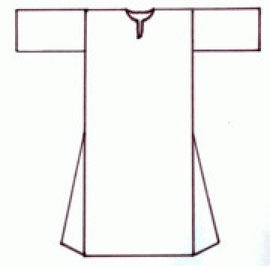
Concerning the length it was normally ankle-length or floor-length for women. It was classified as improper to show the feet. For men instead it rather depends on the time. There were different trends, sometimes ankle-length, than worn to the knee. In 14th century it was only worn to the midth of the thigh. It depends on the respective epoch.
The Cotte was fashioned by linnen or silk and had in the original version the classical basic design (T) of a tunic (as shown in the image above). In this version it was cut straight and had applied sleeves. Front and back part were often so wide, that they reached to the elbow, so that the sleeves failed briefly. This could be up to the fact, that utterly the whole working width of a panel was used to use also the selvages and to avoid any offcut. Finally fabric costed money (or work if selv-woven). A belt gave a form to the from today's perspective much too wide robe.
At court the Cotte was also worn with a train and the vestments were emboridered more gorgeous and furnished with borders when worn without Surcot.
In both versions we also find in waist height inserted wedge-shaped fabric pieces, the so called Gêre, which give more volume and a higher drapery to the lower part of the garment. Sometimes the Gêre were also inserted dirctly under the arms resp. in breast height to veil as much body accents as possible (especially for women). In that form for example repentance garments were produced.
Fishbone
Flexible rod which was used for production of corsage. It is made from bone, horn, metal (mainly steel) or plastic. The name fishbone is based in the fact, that it was made out of whalebone for a long time.
Fripon
Near the end of the 17th century the Panier was replaced by three underskirts lying upon another. Le Fripon or "the tricksy" was the name of the middle of these three underskirts, which was worn over the Secret (the hidden) and under the Modeste (the moderate). The Modeste was opened in front and nested at the side, where the fabric of the Fripon could twinkle forth.