
 Country Family
Baton Rouge
Country Family
Baton Rouge
The Clovis Indians
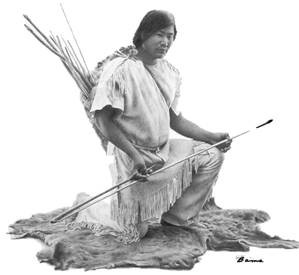
They lived in a hard and merciless world. If an essential mistake happened to a hunter and he sustained dangerous injuries and died, his whole family was threatened. The Clovis-hunters stood in challenge with carnivores and carrion eaters; when they once had a prey it was carefully preserved immediately. They lived together in formless clans, that perhaps consisted of four to ten core families. The leading of such a clan devolved on the most dominant man, who applied his authority by his skill as hunter and breadwinner. Every clan had its own district, the men could hunt everything besides the women. To marry inside of the own clan was as condemnable as incest. But if there were times of fullness the different clans of Clovis-Indians met. Here the men could find a bride. If a girl appealed to them they could take her as bride into the clan.
The adolescent child became acquainted with nature, learnt how to hunt, how to sneak up and where to hide the best. The also became acquainted to mammuts and longhorn bisons, which served as food.
Also the prey deserved a high degree of respect. Who didn't do that was missing hunt success. And so assistance of shamans was required who regulated the preternatural. It appeared as if the hunter had been brought in a kind of trance before the hunt. When they killed an animal the immediately offered their apologies for harming the animal. When the hunt was successfull the carcass was fragmented in the required way. Some bodyparts were outlayed, others ritually consumed. The Clovis-Indians believed that the animal spirits may not be lost, because the meet regenerates und will return on a later date.
The whole experience that a clan made during life was passed over to the offspring orally. The Clovis-Indians were a wandering nation. The men demanded of their wives that they left her own clan and the world, where they grew up. When there was no more prey they had to move on. The Clovis-women were responsible for the following things: dig for roots, gather berries and taking care of the children. A mature woman, that means, when she already has children, can only do work that doesn't lead her too far away from the camp and that she also can do with her children. The women were very important for the daily life, they cooked and took care for constant ressources as food plants and firewood. The had to be embarrassingly accurate with cooking, because if there were too much calories it could be that the whole clan slided in a disaster. A further secret how they managed to survive was, whoever brought prey of hunt or vegetable fare - everyone had a claim of a part of it. The personal hoarding of food was in breach of the unwritten laws of the clan. For centuries the Clovis-Indians expanded and used the at last small ressources.
Nearly eleven thousand years ago the end of the Clovis-culture came, but the Clovis-people continued to exist in another way than their ancestors. It could be said the Clovis-people are the prime fathers of the Indians.
report: Red Cloud