
 Country Family
Baton Rouge
Country Family
Baton Rouge
The migration of a nation
In the year 1832 president Andrew Jackson commanded the banishment of the Indian tribes from the southeast of the United States. The Mukogee were then relocated together with the Chickasaw, the Choctaw and the Cherokee. They covered the long way to the "Indian territory", the later Oklahoma - a Choctaw word, that means "land of the red man" - by foot. In the official historiography this relocation of the Indian tribes is mentioned, never mentioned were the emotions, that were connected for their nation, what they had to leave behind and which stresses and strains were required.
It was a compulsory change of residence, we had no choice. When the nation refused to leave the ancestral dwelling the soldiers pulled a little child from the arms of a mother and hit its head against a tree. Then they said: "Go or we do this with all the children here". It is told that some soldiers disembowelled pregnant women with their sabres. So our nation was constrained to leave its homeland.
The Indians went the whole way by foot, from dawn till sunset, driven forward by mounted soldiers. They didn't even give us the time to decently bury the old, that died on the way. Much of our beloved sisters and brothers were left behind in canyons, the bodies covered provision with leaves and branches. It was a long march, the people were very outspent and the little children couldn't keep pace with the adults, so that the men had to carry them alternately. But they also hadn't the power to carry them the whole time through, that's why somy children and mothers had to stay back. These are only some stresses and strains that our ancestors had to agonize on the way; the called it "trail of tears", because this injustice provoked big crying and lamentation.
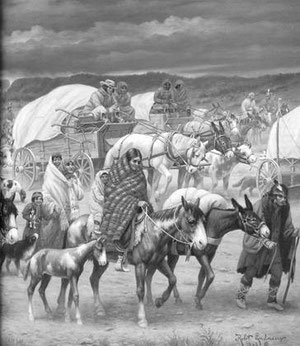
A man, who had witnessed the long march as child, reported on that migration. At any time the people together with their horses were driven on twelve rotten boats, that should bring them to the other shore of the Mississippi. His boat began to sink, therefore he caught his sister and vaulted on the horse to reach the other shore faster, chased by the soldier that wanted debar him. But the horse had to swim and got along slowly, because it was afraid. He had seen how brute the soldiers could be and that they had deliberately overloaded the boats, that's why he knew, his life was at stake. Then anybody else on another horse came up and reached for his sister. "When I had reached the other shore, I have cried", told the man, "because I thought, the soldiers had taken my sister with them. But later I learned that one of my own people had helped me."
During the traverse of the Mississippi many people died. Most of the survivors were completely soaked when they reached the other shore and it was freezing cold. An old woman, exhausted and confused from all the stresses and strains didn't know anymore, where she was - she thought to be back at home - and gave instructions to the younger to fetch dry wood.
Equal how the weather was, they had to go forward and their feet froze to death because they had to walk throug the snow without shoes.
When the Indians finally were allowed to settle this meant in no case the end of all sorrows. So the children were separated from their parents und forced to visit a residential school, where they should only speak english. The residential school was a state-owned school and the children were forced to march in and out of the school room in military order, to make the beds and to treat as in a casern. Till then it was the whole pride of the Indians to wear the hair long, but the children had to cut them short. Sometimes the advisor put a bowl over the head of a child and cut around, afterwards they laughed at the child.
And nevertheless we pray till today for the whole human race. And we still bring up much love for other people. We even pray for those that harmed us and love them like our own sisters and brothers.
report: Red Cloud